Sarah had dreamed of opening her boutique cafe for years. When she finally found a space with affordable rent on a busy street in downtown Austin, she jumped at the opportunity. The landlord needed a quick decision, and the monthly rent was $500 less than comparable spaces she’d seen. It seemed like the perfect start.
Eight months later, Sarah closed the doors for good. Despite working 80-hour weeks and investing her entire savings, the cafe never achieved profitability. The “busy street” had high vehicle traffic but virtually no foot traffic. The affordable rent came with a catch—the space was on the second floor with no street-level visibility. Parking was nearly impossible, and her target customers (working professionals) worked in office buildings three miles away.
Sarah’s total loss: $127,000 in lease payments, buildout costs, equipment, inventory, and marketing expenses that couldn’t overcome a fundamentally wrong location.
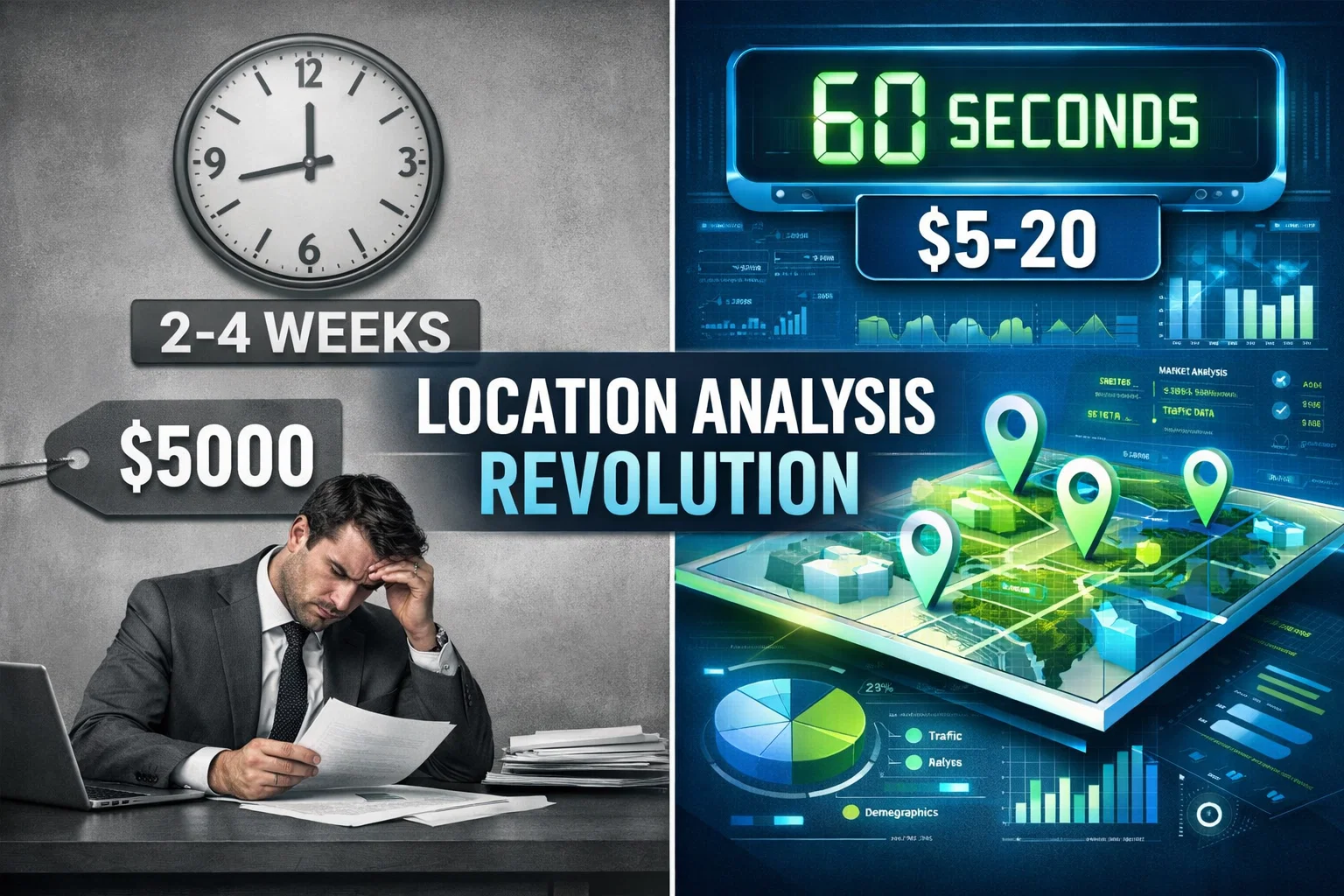
She’s not alone. According to the U.S. Small Business Administration, poor location choice contributes to 60% of new business failures. What makes this especially painful is that location mistakes are entirely preventable with proper analysis. The tragedy isn’t just the financial loss—it’s that entrepreneurs sacrifice years of their lives and their life savings on a problem that could have been identified in 60 seconds with the right tools.
The Obvious Costs Everyone Sees {#obvious-costs}
When entrepreneurs think about the cost of choosing the wrong business location, they typically focus on the immediate, visible expenses. These are real and substantial, but they’re just the beginning.
Wasted Lease Deposits and Rent
Most commercial leases require first month, last month, and a security deposit equal to 1-3 months of rent. For a space renting at $3,000/month, you’re looking at $9,000-$15,000 upfront before you’ve served a single customer or made a single sale. When the location doesn’t work out, this money is gone. Even if you break the lease early, you’ll likely forfeit your security deposit and still owe several months of rent.
Conservative estimate: $15,000-40,000 depending on your market and lease terms.
Buildout and Renovation Costs
Transforming a raw commercial space into a functioning business requires significant investment. Restaurant buildouts typically cost $100-300 per square foot. A modest 1,000 square foot cafe could require $50,000-150,000 in buildout costs alone. Retail stores need shelving, lighting, fitting rooms, and point-of-sale systems. Gyms need specialized flooring, mirrors, and equipment installations.
None of this investment is portable. You can’t take the commercial kitchen or custom millwork with you. When you choose the wrong location, these buildout costs represent complete loss.
Conservative estimate: $20,000-100,000 depending on business type and space condition.
Equipment and Inventory Investments
Beyond the buildout, you’ve invested in equipment, furniture, and initial inventory. Some equipment can be moved to a new location, but often at significant cost or with depreciation. Perishable inventory is a total loss. Industry-specific equipment may have limited resale value.
A restaurant might have $30,000 in kitchen equipment, $10,000 in dining furniture, and $5,000 in initial food inventory. A retail store could have $40,000 in inventory and $15,000 in fixtures. A gym might have $60,000 in exercise equipment.
Conservative estimate: $10,000-50,000 in non-recoverable or depreciated assets.
Early Lease Termination Penalties
Most commercial leases are 3-5 year commitments. Breaking a lease early typically requires paying several months of remaining rent. If you’re 8 months into a 3-year lease at $4,000/month, you might owe 6-12 months as a penalty—another $24,000-48,000. Some landlords negotiate lower penalties, but many enforce the full terms, especially if they’re having difficulty finding new tenants.
Conservative estimate: $10,000-60,000 depending on lease terms and timing.
These obvious costs alone can total $55,000-250,000. But they’re actually the smaller part of the problem.
The Hidden Costs Most Entrepreneurs Miss {#hidden-costs}
The visible losses are painful, but the hidden costs of a wrong business location often exceed them by 2-3x. These are the expenses and impacts that don’t show up on your profit and loss statement but devastate your financial future nonetheless.
Opportunity Cost: The Biggest Loss You Can’t See
Opportunity cost is the profit you would have earned in the right location. This is the most financially significant impact of a location mistake, yet entrepreneurs rarely calculate it.
Consider two scenarios:
Scenario A (Wrong Location): You operate for 12 months before closing. Monthly revenue averages $8,000. After expenses of $12,000/month, you lose $4,000 monthly or $48,000 total. You walk away with zero and a $175,000 total loss including all the obvious costs.
Scenario B (Right Location): With proper location analysis, you choose a site with strong demographics, appropriate competition levels, and good accessibility. Monthly revenue averages $28,000. After expenses of $18,000/month, you profit $10,000 monthly or $120,000 annually. After three years, you’ve generated $360,000 in profit and built a business worth $500,000+ in enterprise value.
The opportunity cost of the wrong location: $360,000 in lost profit plus $500,000 in lost enterprise value = $860,000.
This assumes you eventually try again and succeed. Many entrepreneurs never recover from their first location failure—they’ve depleted their savings and lost access to capital. For them, the opportunity cost is infinite: the business they could have built but never will.
Real example: Marcus wanted to open a CrossFit gym. Location A had cheap rent ($2,500/month) but poor demographics—mostly retirees and young families in a car-dependent suburb. Location B cost $4,500/month but was near office complexes and upscale apartments with his exact target demographic (professionals 25-45).
Intimidated by the higher rent, Marcus chose Location A. After 14 months, he closed with $95,000 in losses. If he’d chosen Location B, our analysis shows he likely would have achieved 120 members at $150/month ($18,000 monthly revenue) within 6 months, generating $6,000/month profit after the higher rent. His opportunity cost: $84,000 in lost profit, plus the $95,000 he actually lost, totaling $179,000.
Excessive Marketing Expenses to Overcome Poor Location
A great location markets itself through foot traffic, visibility, and word-of-mouth from a concentrated customer base. A poor location requires constant, expensive marketing to drive customers from far away.
The marketing multiplication effect: Restaurants in optimal locations typically spend 2-3% of revenue on marketing. Restaurants in poor locations often spend 10-15% of revenue trying to overcome their location disadvantage through advertising, delivery promotions, and discounts.
A cafe in a prime downtown location with office workers and residents nearby might spend $500/month on local marketing. The same cafe in a poor location might spend $3,000-5,000/month on Google Ads, Instagram promotions, delivery platform fees, and constant discounting—and still generate lower revenue.
Over 12 months, that’s an extra $30,000-54,000 in marketing waste. Over three years, it’s $90,000-162,000 you could have invested in quality improvements, staff, or your own salary.
Real example: A juice bar opened in a strip mall with poor visibility and no foot traffic. The owner spent $4,200/month on Facebook ads, Google ads, and delivery promotions trying to build awareness. A competitor opened six months later in a high-traffic downtown location with natural foot traffic. They spent $600/month on marketing and generated 3x the revenue. The first owner burned through $50,400 in marketing over 12 months before closing. The downtown location made that same $50,400 in profit.
Operational Inefficiencies That Drain Resources
Location impacts far more than customer access. It affects your entire operational cost structure.
Staff recruitment and retention: Employees consider commute time when choosing jobs. A location with poor public transit access or far from where your target employees live creates constant turnover. Each employee replacement costs approximately $4,000-6,000 in recruiting, training, and productivity loss. If poor location drives 50% annual turnover (4-6 employees in a typical small business), that’s $16,000-36,000 annually in preventable turnover costs.
Supplier and delivery logistics: Restaurants in inconvenient locations pay more for deliveries and may have fewer supplier options. Retail stores far from distribution centers face higher shipping costs and longer replenishment times. These costs add up to $500-2,000 monthly or $6,000-24,000 annually.
Inventory management problems: Locations with unpredictable traffic patterns make inventory management nearly impossible. You overstock (tying up capital and increasing waste) or understock (losing sales). For restaurants, this waste can reach 10-15% of food costs. A restaurant with $15,000 monthly food costs losing 12% to waste = $1,800/month or $21,600 annually.
Utility and maintenance: Some locations come with higher utility costs (older buildings, poor insulation) or frequent maintenance issues. These might add $300-800 monthly or $3,600-9,600 annually.
Combined operational inefficiency cost: $27,000-91,000 annually or $81,000-273,000 over three years.
Psychological and Health Costs
The financial impact is measurable. The personal cost is incalculable.
Entrepreneurs with failing businesses due to location mistakes report:
Chronic stress and anxiety: Lying awake at night wondering how to make rent. Constant worry about cash flow. The emotional burden of watching your dream fail despite working harder than you’ve ever worked. This stress manifests in measurable health problems.
Physical health deterioration: Studies show entrepreneurs dealing with failing businesses have 25% higher rates of cardiovascular problems, sleep disorders, and stress-related illness. Medical expenses and reduced quality of life have real costs, even if they’re hard to quantify.
Relationship strain: Failed businesses due to preventable mistakes are a leading cause of divorce and family conflict. The financial pressure combined with time away from family creates tremendous relationship stress.
Mental health impact: Depression and anxiety disorders are significantly elevated among entrepreneurs dealing with business failure, especially when they recognize the failure was preventable. The “I should have known” regret is particularly toxic.
Delayed recovery: The psychological impact of a location-driven failure often prevents entrepreneurs from trying again for 3-5 years or permanently. The cost isn’t just the current business—it’s every future business you don’t start.
While these costs don’t appear on balance sheets, they represent profound life impact. One entrepreneur described it as “losing three years of my life I’ll never get back, plus my marriage and my health, all because I didn’t spend $5 on proper location analysis.”
Reputation and Future Capital Access Damage
Your first business failure creates a permanent record that affects future opportunities.
Landlord references: Commercial landlords check references. A failed lease and potential litigation creates a negative record. Future landlords will ask why your previous location failed. Even when you have a good explanation, it raises red flags. You’ll face higher deposits, personal guarantee requirements, or outright rejection.
Investor and lender skepticism: If you seek funding for a second venture, investors and banks will discover your first failure. While many successful entrepreneurs have failures in their history, a failure due to obvious location mistakes (preventable with basic analysis) suggests poor judgment. This raises capital costs or eliminates access entirely.
Supplier relationships: Suppliers you couldn’t pay become cautious about extending credit terms. You’ll face cash-on-delivery requirements that hurt cash flow in future ventures.
Personal credit impact: Many entrepreneurs personally guarantee leases and business loans. Defaults show up on personal credit reports, affecting your ability to buy a home, get a car loan, or secure future business credit for 7 years.
Opportunity cost of reputation: The difference between securing funding at 8% vs. 15% interest on a $100,000 loan over 5 years is $19,000 in additional interest. The difference between a landlord accepting your application vs. rejecting it might be the difference between starting your next business or not.
Combined reputation cost: $15,000-50,000 in higher capital costs, deposits, and restricted opportunities.
Real Case Studies of Location Failures {#case-studies}
Let’s examine three real location failures in detail (names changed for privacy).
Case Study 1: The “High Traffic” Restaurant That Had No Customers
Business: Maria’s Mediterranean Kitchen
Location: High-traffic arterial road in suburban Phoenix
Duration: 10 months before closing
Total loss: $78,000
What looked good: The location was on a road with 45,000 vehicles passing daily. Rent was $3,200/month, reasonable for a 1,600 square foot space. Maria had visited during lunch rush and seen heavy traffic.
What went wrong: The high traffic was commuters driving 45-50 mph with no reason to stop. The restaurant was in a strip mall set back from the road with difficult left-turn access during peak hours. There was adequate parking, but the entrance wasn’t visible until you were right on top of it. Most importantly, there were virtually no residents or office workers within walking distance—everyone had to drive there intentionally.
The data Maria didn’t analyze:
- Demographics within 1 mile: Only 2,400 residents (extremely low density)
- Average household income within 3 miles: $48,000 (below her target customer)
- Competition: Three established Mediterranean restaurants within 2 miles with better locations
- Foot traffic: Zero (everyone had to drive)
- Accessibility score: Poor (difficult left turns, highway speeds made it dangerous)
Cost breakdown:
- Lease deposits and 10 months rent: $35,200
- Kitchen buildout: $22,000
- Equipment and furnishings: $14,000
- Initial inventory: $3,500
- Marketing (heavy spending to overcome location): $18,000
- Lease break penalty: $9,600
- Total: $102,300 invested, $24,300 recovered from equipment sales = $78,000 loss
What proper analysis would have revealed: The location scored 3.2/10 for a sit-down Mediterranean restaurant. A location analysis would have shown the low residential density, demographic mismatch, and accessibility problems immediately. Alternative locations scoring 7.5+/10 were available at similar or slightly higher rent in mixed-use developments with office workers and higher-income residents.
Opportunity cost: If Maria had chosen the better location, revenue modeling suggested she could have achieved $35,000-40,000 monthly revenue vs. the $12,000 she averaged. Over three years, the opportunity cost was approximately $630,000 in lost profit and enterprise value.
Case Study 2: The “Affordable Rent” Gym That Attracted the Wrong Market
Business: FitCore Training
Location: Industrial area in Cleveland transitioning to mixed-use
Duration: 18 months before closing
Total loss: $143,000
What looked good: Rent was only $4,500/month for a huge 3,500 square foot space (typical rent for that size gym would be $8,000-10,000). The landlord pitched the area as “up and coming” with new residential developments planned. The low rent meant Tom needed only 60 members at $120/month to break even.
What went wrong: The area was transitioning, but the transition was 3-5 years away from completion. Current demographics were mostly low-income residents in aging apartment complexes. The planned luxury apartments were delayed by 2 years due to financing issues. The low-income demographics meant price sensitivity—$120/month was too expensive for most nearby residents. Tom struggled to attract his target market (professionals earning $60K+) because they had to drive 15-25 minutes from their neighborhoods.
The data Tom didn’t analyze:
- Current median income within 2 miles: $34,000 (vs. his target of $60,000+)
- Age distribution: Skewed older (45% over age 55) when his service targeted 25-45
- Competition: Two budget gyms ($19/month) already serving the current demographics
- Market trends: Residential development was delayed; permits showed 3-year timeline, not 12 months
- Traffic patterns: Area was dead after 6pm and on weekends (industrial workers only)
Cost breakdown:
- Lease deposits and 18 months rent: $94,500
- Gym buildout (flooring, mirrors, paint): $28,000
- Equipment: $45,000
- Marketing: $32,000 (trying to attract customers from 15+ miles away)
- Operating losses (revenue minus variable costs): $67,000
- Equipment sale recovery: $18,000
- Lease break penalty: $13,500
- Total: $280,000 invested, $137,000 recovered/reduced = $143,000 loss
What proper analysis would have revealed: The location scored 4.1/10 for a premium gym currently, with a projected 7.2/10 in 3 years when demographic transition completed. A location analysis would have shown Tom either needed to: (a) delay opening by 2-3 years, (b) adopt a budget gym model for current demographics ($29/month memberships), or (c) choose a different location that already had his target demographics.
Opportunity cost: Tom gave up his job as a personal trainer earning $65,000/year to open the gym. Over 18 months, he lost $97,500 in foregone salary plus the $143,000 business loss = $240,500 total impact. If he’d chosen the right location or right business model for this location, he could have been profitable and earning $100,000+ annually from the gym.
Case Study 3: The “Perfect Spot” Retail Store in a Declining Area
Business: Urban Threads (boutique clothing)
Location: Historic downtown shopping district in mid-sized Midwest city
Duration: 14 months before closing
Total loss: $67,000
What looked good: Downtown had historic charm with beautiful old buildings. The specific block had several other boutiques and seemed like a retail cluster. Foot traffic looked good during her weekend visits. Rent was $2,800/month for a prime corner unit with great windows. The landlord spoke enthusiastically about downtown revitalization plans.
What went wrong: The downtown was in decline, not growth. Foot traffic was artificially high during her weekend scouting visits due to a farmers market (seasonal, ending in October). Year-round weekday traffic was sparse. Three other boutiques on the block were struggling; one closed during Jessica’s second month. The “revitalization plans” were aspirational with no actual funding or timeline. Parking was challenging and expensive ($1.50/hour meters), discouraging shopping trips. The area’s demographic trend was negative—young professionals were moving to suburban mixed-use developments.
The data Jessica didn’t analyze:
- Trend analysis: Downtown retail sales down 18% over previous 3 years
- Real estate prices declining 3% annually (signal of area in decline)
- Parking accessibility: Only metered street parking and one garage charging $8/day
- Demographic trends: Population within 2 miles declining, median age increasing
- Competition: Five boutiques within 3 blocks, with three showing declining revenues
- Market research: Revitalization plan was concept-stage only with no approved funding
Cost breakdown:
- Lease deposits and 14 months rent: $44,800
- Retail buildout (fitting rooms, shelving, lighting): $18,000
- Initial inventory: $32,000
- Marketing: $15,000
- Operating losses: $41,000
- Lease break penalty: $8,400
- Inventory liquidation (recovered 40% of cost): -$12,800
- Fixtures recovery: -$4,400
- Total: $159,200 invested, $92,200 net loss = $67,000 loss
What proper analysis would have revealed: The location scored 5.8/10 currently for boutique retail, but trend analysis showed it declining to 3.5/10 within 2 years. A proper location analysis would have identified the declining market trends, the parking accessibility issues, and the oversaturated boutique market. Alternative locations in growing suburban mixed-use developments scored 8.2/10 with better demographics, free parking, and growing foot traffic.
Opportunity cost: Jessica used $85,000 of savings accumulated over 8 years. After the failure, it took her 4 years to rebuild savings and confidence to try again. If she’d chosen the right location initially, revenue modeling suggested $28,000-32,000 monthly revenue vs. the $11,000 she averaged. Over three years, the opportunity cost was approximately $450,000 in lost profit and enterprise value, plus 4 years of her prime working life.
The Actual Dollar Impact Breakdown {#dollar-impact}
Let’s consolidate everything into a comprehensive financial model showing the true cost of choosing the wrong business location.
Complete Cost Analysis: Wrong Business Location
| Cost Category | Conservative | Typical | Worst Case |
|---|---|---|---|
| OBVIOUS COSTS | |||
| Lease deposits & rent (12 months) | $18,000 | $36,000 | $60,000 |
| Buildout & renovation | $20,000 | $50,000 | $120,000 |
| Equipment & furniture | $15,000 | $35,000 | $75,000 |
| Initial inventory | $5,000 | $15,000 | $30,000 |
| Lease break penalties | $8,000 | $20,000 | $45,000 |
| Obvious Costs Subtotal | $66,000 | $156,000 | $330,000 |
| HIDDEN COSTS | |||
| Opportunity cost (lost profit) | $60,000 | $180,000 | $450,000 |
| Excessive marketing spend | $18,000 | $42,000 | $72,000 |
| Operational inefficiencies | $15,000 | $35,000 | $65,000 |
| Staff turnover costs | $12,000 | $24,000 | $40,000 |
| Inventory waste | $6,000 | $15,000 | $28,000 |
| Health & stress costs | $5,000 | $12,000 | $25,000 |
| Reputation damage impact | $10,000 | $25,000 | $50,000 |
| Hidden Costs Subtotal | $126,000 | $333,000 | $730,000 |
| TOTAL FINANCIAL IMPACT | $192,000 | $489,000 | $1,060,000 |
Key insights from this analysis:
- Hidden costs exceed obvious costs by 2:1 ratio: For every dollar you see losing, you’re losing $2 more that’s invisible.
- Opportunity cost dominates: The profit you don’t earn in the right location is larger than all the money you actively lose in the wrong location.
- Time multiplies impact: These figures assume 12-18 month failures. Entrepreneurs who persist for 2-3 years trying to make a wrong location work double or triple these losses.
- Business type affects scale: Restaurants and gyms with high buildout costs hit worst-case scenarios more often. Retail and service businesses trend toward typical or conservative ranges.
- Market dynamics matter: Failing in expensive markets (San Francisco, New York, Los Angeles) pushes toward worst case. Smaller markets trend toward conservative.
Real ROI Comparison: Right vs. Wrong Location
Let’s model two parallel universes for the same entrepreneur with $100,000 in startup capital:
Universe A: Wrong Location (No Analysis)
- Month 0: Invest $100,000
- Months 1-12: Lose $3,000/month average (revenue $9K, expenses $12K)
- Month 12: Close business, recover $15,000 from equipment
- Final result: -$121,000 total loss, depleted savings, no business
Universe B: Right Location (With Analysis)
- Month 0: Invest $100,000 plus $15 for location analysis
- Months 1-3: Break even (revenue $15K, expenses $15K)
- Months 4-12: Average $4,000/month profit (revenue $22K, expenses $18K)
- Year 2: Average $8,000/month profit (revenue $28K, expenses $20K)
- Year 3: Average $12,000/month profit (revenue $35K, expenses $23K)
- Final result after 3 years: +$276,000 profit, business worth $400K+ in enterprise value
Difference between Universe A and Universe B: $797,000
That’s the price of skipping a $15 location analysis. The opportunity cost of ignorance is extraordinary.
Warning Signs You’re Making a Location Mistake {#warning-signs}
Most location mistakes are predictable. Here are the red flags that indicate you’re about to make an expensive error:
Red Flags in Your Decision-Making Process
❌ “The rent is too good to pass up” thinking
When rent seems like a great deal compared to comparable spaces, there’s always a reason. Maybe it’s hard to access. Maybe the area is declining. Maybe previous tenants failed. Below-market rent isn’t a bargain—it’s a warning sign that requires investigation.
✅ What to do instead: Understand why rent is low. Analyze 3-4 comparable spaces and determine if the lower price reflects genuine value or hidden problems.
❌ Making decisions based on one or two site visits
Visiting a location Tuesday at 2pm tells you nothing about Saturday morning traffic, Thursday evening patterns, or seasonal variations. Single visits create false impressions.
✅ What to do instead: Visit at minimum 5 different times: weekday morning, weekday lunch, weekday evening, Saturday, and Sunday. Or use AI-powered location analysis that processes continuous data.
❌ Ignoring competition because “we’ll be different”
Every entrepreneur believes their business will be better than competitors. Sometimes it’s true. But being better doesn’t overcome being in an oversaturated market or wrong location for your specific model.
✅ What to do instead: Analyze competition objectively. If there are 5 similar businesses within 1 mile, understand why 5 can succeed there or recognize the market is saturated.
❌ No demographic analysis
Opening a business without understanding who lives and works nearby is gambling. You’re assuming your target customer exists in sufficient numbers at this location.
✅ What to do instead: Verify demographic match: income levels, age distribution, household types, and spending patterns align with your business model.
❌ Landlord pressure (“decide today or lose it”)
Landlords use urgency to prevent due diligence. Any landlord who won’t give you 48-72 hours to analyze the location is hiding something or lying about competing interest.
✅ What to do instead: Never sign under pressure. If the landlord says another tenant is interested, respond: “That’s fine. If they take it, it wasn’t meant to be. I need 72 hours to complete analysis.”
❌ Friends and family opinions instead of data
Your mother-in-law thinks it’s a great spot. Your friend who knows nothing about business loves it. Your spouse’s gut feeling is positive. None of this matters. Personal opinions are not market analysis.
✅ What to do instead: Appreciate the support, ignore the advice, and use data. People who love you will support any location—you need objective analysis.
❌ “Build it and they will come” mentality
This works in movies. In real business, if you build it in the wrong location, they won’t come no matter how good your product is. Great businesses fail in wrong locations every day.
✅ What to do instead: Recognize that location IS marketing. The best product in an invisible, inaccessible location will fail.
❌ Comparing to different business types
“There’s a successful Starbucks on this block, so my smoothie bar will work too.” Different businesses have different location requirements. Coffee benefits from commuter traffic; smoothies need health-conscious residents.
✅ What to do instead: Compare only to similar business types. A successful coffee shop doesn’t predict success for a wine bar, bookstore, or salon.
❌ Not analyzing foot traffic patterns
Assuming traffic is traffic. Morning commuter traffic doesn’t help a bar. Lunchtime office worker traffic doesn’t help a dinner restaurant. Evening traffic doesn’t help a breakfast cafe.
✅ What to do instead: Verify traffic patterns match your business hours and customer type. Use AI analysis that shows hourly and day-of-week patterns.
❌ Skipping accessibility assessment
“People will find a way to get here if they want to.” No, they won’t. Difficult parking, poor transit access, or low visibility kills businesses even when other factors are strong.
✅ What to do instead: Physically test the customer journey: Can you find parking in under 5 minutes? Can you walk from the nearest metro in under 8 minutes? Is the entrance obvious from the street?
Location-Specific Red Flags
🚩 Previous tenant in same category failed: If a restaurant failed in the space and you’re opening a restaurant, that’s not coincidence—the location likely doesn’t support the category.
🚩 Multiple past tenant failures: If 3+ businesses have failed in the space in 2 years, the problem is the location, not the businesses.
🚩 Landlord won’t provide previous tenant information: Transparency matters. Refusal to share tenant history suggests problems.
🚩 Area shows visible decline: Empty storefronts increasing, property maintenance declining, “For Lease” signs proliferating—these signal market problems.
🚩 Your visits show sparse customer traffic at peak times: If you visit during lunch rush or Saturday afternoon and see few customers at nearby businesses, that’s the future for your business.
🚩 Parking is challenging when you visit: If you struggled to find parking during your site visit, imagine how your customers will feel.
🚩 You can’t articulate why customers will come here: If your answer to “Why will customers come to this location?” is vague or hopeful rather than data-driven, you don’t understand the location.
🚩 Comparable successful businesses are all in different areas: When you research competitors, if all the successful ones are in neighborhoods different from your proposed location, that’s revealing.
🚩 Real estate agents or consultants warn you: When professionals who see hundreds of locations tell you to reconsider, listen.
🚩 The numbers “just barely” work: If your pro forma shows you need 95% of projected revenue to break even, you have no margin for error. Wrong locations always underperform projections.
How to Prevent Expensive Location Mistakes {#prevention}
Now that you understand the costs and warning signs, here’s your systematic approach to avoiding location disasters:
Step 1: Never Skip Professional Analysis
The fatal assumption: “I’ll know a good location when I see it.”
No, you won’t. Human intuition is terrible at evaluating business locations. We’re biased by aesthetics (pretty buildings), recency (recent visits), and optimism (seeing what we want to see). Professional location analysis removes these biases.
The cost-benefit analysis:
- Professional analysis: $5-20 (AI-powered) or $500-5,000 (traditional consultant)
- Cost of wrong decision: $50,000-1,000,000
- ROI: 2,500x to 200,000x
There is no business decision with better ROI than proper location analysis. None.
Action items:
- Budget $15-50 for AI-powered location analysis as a non-negotiable expense
- Analyze every location you’re seriously considering before negotiating leases
- Use analysis to eliminate poor options early, saving time on bad opportunities
Step 2: Analyze Multiple Locations (Minimum 3-5)
The fatal assumption: “This is the only available space that fits my criteria.”
It’s not. Your criteria might need adjusting, or you need to wait, but making a decision because you only considered one option is negligent.
Why multiple locations matter:
Analyzing multiple locations accomplishes three things:
- Comparative perspective: You can’t judge if a 7.2/10 location is good without comparing it to a 8.5/10 and a 5.9/10 option. Relative ranking reveals the best choice.
- Negotiating leverage: When landlords know you’re considering alternatives, you have negotiating power. Single-option desperation leads to poor lease terms.
- Pattern recognition: Analyzing 5 locations reveals what characteristics drive success in your market. You start understanding what matters.
Action items:
- Identify 5-7 possible locations before starting serious analysis
- Run quick AI analysis on all options to eliminate bottom performers
- Focus detailed consideration on top 3 scored locations
- Use comparative data in lease negotiations
Step 3: Trust Data Over Gut Feeling
The fatal assumption: “My instincts are good. I have a feeling about this place.”
Your instincts aren’t trained for this decision. You might have great instincts about product, service, or hiring, but location analysis requires processing dozens of variables simultaneously. Humans can’t do this reliably.
Why gut feel fails for location decisions:
- Confirmation bias: You want a location to work, so you unconsciously emphasize positive signals and dismiss negative ones.
- Availability bias: You remember the one successful business in a challenging location but forget the 10 that failed.
- Optimism bias: Entrepreneurs are optimistic (that’s why they start businesses), but optimism doesn’t change demographic realities.
- Single-visit bias: One site visit creates a snapshot that may not represent typical conditions.
The data-driven alternative:
AI-powered location analysis processes 50+ variables simultaneously:
- Demographics (income, age, household composition)
- Competition density and pricing
- Foot traffic patterns across all times/days
- Accessibility scores (parking, transit, walking)
- Market trends over 1-3 years
- Revenue projections based on all factors
Human brains can’t integrate this many variables reliably. Data can.
Action items:
- Get location analysis BEFORE falling in love with a space
- If data contradicts gut feel, trust the data 90% of the time
- When gut and data agree, move forward with confidence
- When gut and data disagree, understand why—often you’re reacting to aesthetics (pretty building) rather than business fundamentals
Step 4: Consider Alternative Business Types for Your Location
The fatal assumption: “I know what business I want to open, so I’ll find a location for that.”
Sometimes the better path is finding a great location and choosing the optimal business type for that location’s characteristics.
The “Better Opportunities” approach:
Modern AI location analysis doesn’t just evaluate your chosen business type—it suggests alternative concepts that might perform better at the same location.
Example: You want to open a wine bar. AI analysis of your chosen location reveals:
- Your wine bar concept scores 6.8/10 at this location
- The same location scores 8.9/10 for a farm-to-table restaurant
- It scores 8.2/10 for a specialty coffee roastery
- It scores 7.1/10 for a coworking space with cafe
This doesn’t mean abandon your wine bar dream—but it reveals that if your goal is business success at this location, you have better options. Or if you’re committed to the wine bar concept, you should find a different location where it scores 8.5+/10.
Action items:
- Use location analysis that includes “Better Opportunities” suggestions
- Be flexible about business concept if a location is particularly strong
- Be flexible about location if you’re committed to a specific concept
- Optimize for success, not for your initial assumption
Step 5: Project Long-Term, Not Just Year 1
The fatal assumption: “If I can survive the first year, I’ll figure it out.”
Location decisions compound over time. A mediocre location doesn’t get better—it often gets worse as competition adapts and market conditions change.
Time horizons matter:
Most leases are 3-5 years. Your location analysis should match this timeframe:
- Year 1: Can you achieve break-even with realistic effort?
- Year 2: Can you achieve reasonable profit (10-15% margin)?
- Year 3: Can you scale or build enterprise value?
- Years 4-5: Is the market growing, stable, or declining?
A location that works for Year 1 but fails in Years 2-3 due to market decline or competition is still a bad location.
Market trend analysis reveals:
- Gentrifying neighborhoods (improving over time)
- Stable mature markets (consistent performance)
- Declining areas (deteriorating over time)
- Emerging markets (uncertain trajectory)
Action items:
- Request 3-year revenue projections in your location analysis
- Analyze market trends: Is the area improving or declining?
- Research planned developments: New residential, commercial, or transit?
- Consider exit strategy: If you want to sell in 3-5 years, will location support enterprise value?
Step 6: Calculate Your Break-Even Reality
The fatal assumption: “I’ll make it work through hustle and determination.”
Hustle matters, but it can’t overcome fundamental location economics. You need to know your break-even requirements and whether the location can realistically achieve them.
Break-even analysis:
Before committing to any location, calculate:
- Fixed monthly costs: Rent + utilities + insurance + minimum staff + baseline marketing
- Variable costs per customer: Cost of goods sold + variable labor
- Required customer volume: Fixed costs ÷ (Average transaction – variable cost per customer)
- Market capacity: Does the location have enough accessible customers to hit required volume?
Example:
Your cafe has:
- Fixed monthly costs: $18,000 (rent $6K, staff $8K, utilities/insurance $2K, marketing $2K)
- Average transaction: $12
- Variable cost per transaction: $5 (COGS $4, variable labor $1)
- Contribution margin: $7 per transaction
- Break-even requirement: $18,000 ÷ $7 = 2,571 transactions/month or 86 per day
Now ask: Does this location realistically generate 86 customer transactions per day for a cafe?
If foot traffic analysis shows 200 people walk by daily and typical conversion for cafes is 10-15%, you’re looking at 20-30 customers per day. You’ll lose money every single month.
This reality doesn’t change through better coffee or harder work. The location cannot support the business model.
Action items:
- Calculate exact break-even customer volume before choosing location
- Use location analysis to project realistic customer volume
- Build in 20-30% margin of safety (don’t choose locations where you need 95% of projected volume)
- If numbers don’t work, adjust the business model or choose a different location
The ROI of Proper Location Analysis {#roi}
Let’s bring this full circle with the return on investment calculation that every entrepreneur should understand.
Investment Comparison: Analysis vs. Ignorance
Option A: Skip Analysis (Current Industry Standard)
- Cost: $0
- Time saved: 60 seconds
- Decision quality: Based on gut feel and limited observation
- Result: 40-60% chance of choosing wrong location
- Expected loss: $50,000-300,000
- Expected value: -$95,000 (assuming 50% failure rate and average $190,000 loss)
Option B: Professional Analysis (AI-Powered)
- Cost: $5-20
- Time investment: 5 minutes (entering data + reviewing report)
- Decision quality: Data-driven with 50+ variables analyzed
- Result: 15-25% chance of choosing wrong location (75-85% improvement)
- Expected loss: $12,500-75,000 (much lower likelihood and better early detection)
- Expected value: -$23,750 + $15 cost (assuming 20% failure rate and average $118,750 loss)
Value created by analysis: $71,250 expected value improvement
ROI: 475,000% (on a $15 investment)
This might be the highest ROI decision available to entrepreneurs.
Real Success Story: The $15 That Saved $127,000
Remember Sarah from the introduction who lost $127,000 on the wrong cafe location?
After recovering financially over 4 years, Sarah was ready to try again. This time, she used AI-powered location analysis before committing.
Her process:
- Identified 6 possible locations in Austin
- Spent $49 on Spotfic’s Professional Package (15 analyses)
- Analyzed all 6 locations plus 3 alternatives the analysis suggested
- Discovered her top choice scored only 6.2/10 for her cafe concept
- Found an alternative location scoring 8.7/10 she hadn’t previously considered
- Chose the 8.7/10 location despite $800/month higher rent
Results after 18 months:
- Monthly revenue: $42,000 (vs. $12,000 at her first location)
- Monthly profit: $9,500 (vs. -$4,000 losses at her first location)
- Total profit over 18 months: $127,500
- Business value (3x annual profit): $342,000
The $49 investment created:
- Avoided loss: $127,000 (prevented repeating first mistake)
- Generated profit: $127,500 (18 months)
- Enterprise value: $342,000
- Total value created: $596,500
ROI: 1,217,857%
Sarah describes it as “the smartest $49 I ever spent. I wish I’d known about this tool 5 years ago.”
Time Value: The Hidden ROI
Beyond money, consider the time value:
Wrong location path:
- 6 months finding and building out wrong location
- 12-18 months trying to make it work
- 6 months recovering financially and emotionally
- Total: 24-30 months lost
Right location path:
- 6 months finding location (with 60-second analyses eliminating bad options quickly)
- 3 months to break-even
- 9-12 months building profitable business
- Total: 18 months to profitability
The right location saves 12+ months of your life plus positions you for sustainable growth.
Enterprise Value Multiplier
Location doesn’t just affect monthly profit—it determines whether your business has sellable enterprise value.
Wrong location:
- Inconsistent revenue
- High customer acquisition costs
- Difficult to scale
- No buyer interest
- Enterprise value: $0
Right location:
- Predictable revenue
- Organic customer acquisition
- Scalable model
- Multiple buyer interest
- Enterprise value: 2-4x annual profit
A profitable business generating $120,000 annual profit is worth $240,000-$480,000 in enterprise value if the location is strong and transferable. The same profit in a wrong location has zero enterprise value because a new owner can’t replicate success.
Location analysis doesn’t just save costs—it creates sellable equity.
Frequently Asked Questions {#faq}
What if I’ve already signed a lease on a location I haven’t analyzed?
Get analysis immediately. Even after signing, understanding your location’s strengths and weaknesses helps you adapt your business model, marketing strategy, and operations to maximize success. If analysis reveals severe problems (scores below 5/10), consider:
- Negotiating lease modification or early termination
- Pivoting to a different business type better suited to the location
- Planning a strategic exit rather than investing more money
- The earlier you identify problems, the less you’ll lose
Can location analysis guarantee my business will succeed?
No analysis guarantees success—execution, product quality, service, and management all matter. However, location analysis can virtually guarantee you avoid preventable location-driven failures. Think of it as: analysis can’t ensure success, but it can prevent a major category of failure. That dramatically improves your odds.
What if my business is truly unique and location analysis doesn’t apply?
Every business has a target customer who lives, works, or travels somewhere. Location analysis applies to unique businesses by analyzing their specific customer demographics, accessibility requirements, and competition from substitute goods. The more unique your business, the more critical proper analysis becomes—you can’t rely on comparable examples, so you need data-driven insights.
How accurate are AI-powered location analyses compared to traditional consultants?
AI-powered analysis achieves 70-80% accuracy using publicly available data—the same accuracy range as traditional consultants. The difference is AI processes more variables simultaneously, eliminates human bias, costs 97% less, and delivers results in 60 seconds instead of weeks. For most small businesses, AI analysis provides equal or better insights at a fraction of the cost.
What if I find a location that scores poorly but I believe in it anyway?
Trust your entrepreneurial instincts but verify them. If you have genuine insight the analysis missed, document it clearly:
- What specific factor does the data miss?
- How will you overcome the identified weaknesses?
- What’s your backup plan if your insight is wrong?
Sometimes entrepreneurs see opportunities data doesn’t capture. Usually, they’re experiencing optimism bias. Be honest with yourself about which applies. Even then, analyze alternative locations—if multiple options score 8+/10 and your “gut feeling” location scores 5.5/10, you’re gambling against strong odds.
Can location analysis help with online/delivery businesses?
Yes. Online businesses still need physical locations for warehousing, fulfillment, or dark kitchens. Analysis for these businesses focuses on:
- Delivery radius demographics
- Proximity to target customer clusters
- Logistics and supplier access
- Labor availability
- Rent efficiency (less focus on visibility, more on operational cost)
The variables differ from retail, but location analysis remains critical.
What if I’m choosing between two locations that both score well?
This is the ideal scenario. When both score 8+/10, you’re choosing between good options. Consider:
- Which has better 3-year growth trajectory?
- Which has lower risk factors?
- Which offers better lease terms?
- Which allows better work-life balance for you?
At this point, personal preference becomes valid since both are fundamentally sound.
How often should I analyze a location before committing?
Analyze once during initial screening to eliminate bad options. If a location scores 7+/10, visit in person, verify assumptions, then run analysis again if circumstances changed. Markets evolve—analysis from 6 months ago may be outdated. Budget for 1-3 analyses per serious location candidate.
What do I do if I can’t find any locations that score well in my desired area?
You have four options:
- Expand your geographic search: Look at adjacent neighborhoods or cities
- Adjust your business model: Modify the concept to better fit available locations
- Wait for market conditions to improve: Some markets aren’t ready for certain concepts yet
- Reconsider the business idea: If no suitable locations exist, the market may not support the concept
All four are better than opening in a poor location and losing $50,000-300,000.
Take Action: Protect Your Investment Today
Location mistakes are expensive, painful, and completely preventable. You now understand:
- The obvious costs ($55,000-250,000 in direct losses)
- The hidden costs ($126,000-730,000 in opportunity cost and indirect impacts)
- The warning signs that predict failure
- The systematic approach to choosing correctly
Every entrepreneur who lost $50,000-300,000 on a wrong location wishes they could go back and spend $15 on professional analysis. You have that opportunity right now.
Your next steps:
- If you’re currently evaluating locations: Stop negotiating until you complete professional analysis. The $5-20 investment will either confirm you’re on the right track or save you from disaster.
- If you’ve signed a lease but haven’t opened: Analyze immediately. Understanding your location’s strengths and weaknesses while you still have time to adapt your business model is crucial.
- If you’re planning to open a business in the next 6-12 months: Start analyzing potential locations now. Build a comparative database. Understand what drives success in your market before you start lease negotiations.
The difference between choosing the right location and the wrong location is literally hundreds of thousands of dollars and years of your life.
Don’t let your business become another cautionary tale.
Analyze your location in 60 seconds at Spotfic.com and make the smartest $5-20 investment of your entrepreneurial journey.